This story was written by Hannah Lochan, Research Officer at the Institute of Marine Affairs (IMA).
Over the past several years, Stony Coral Tissue Loss Disease (SCTLD) has been destroying coral reefs across the Caribbean.
First observed in Florida in 2014, the disease has since spread to 32 other countries in the region.
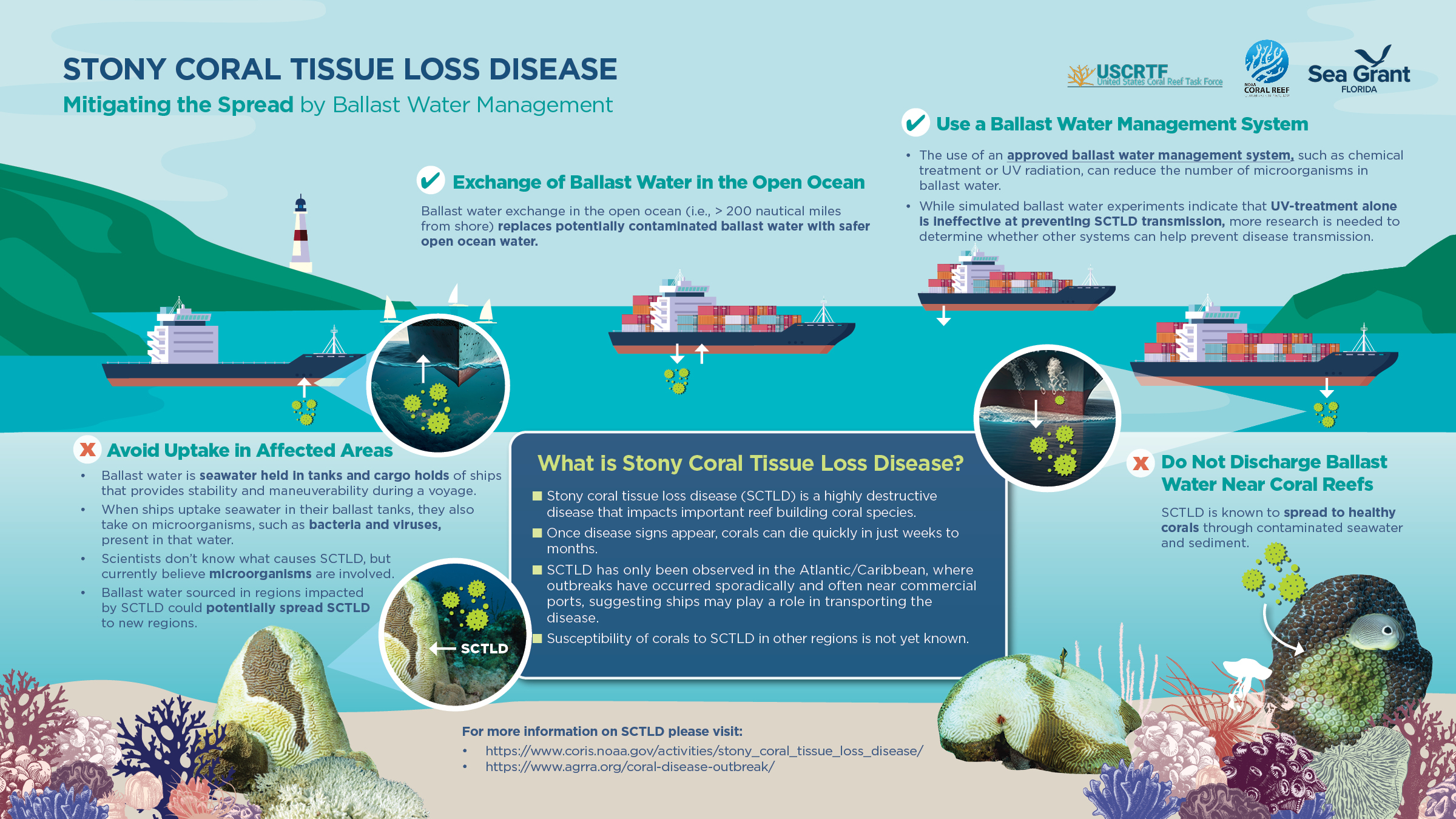
Highly transmissible, the disease’s pathogen is spread through water currents, direct contact with infected corals and ballast water from ships with seaports, often being an early site of infection.
The disease appears as lesions of dead tissue on the coral, and as the infection spreads, these lesions get bigger as more tissue sheds off of the coral.
While other coral diseases exist, SCTLD results in rapid coral mortality, with corals dying within a few weeks to months.

While scientific research is ongoing to determine the exact cause of the disease, research so far indicates that it is caused by bacteria or a combination of virus and bacteria.
This has been the catalyst for action across the Caribbean to preserve the remaining coral populations in the region.
These actions include protocols for treating infected corals with antibiotics and efforts to relocate corals to land-based facilities.
Of the 45 stony coral species found in the Caribbean, the disease infects more than 20 of these.
However, the species most susceptible to infection include the maze, mountainous and brain corals, which are the dominant coral species on Tobago’s reefs.
Even the world-renowned, giant brain coral found in Speyside is a species that is highly susceptible to the disease.

Based on a 2006 estimate, the annual value of Tobago’s coral reefs is between 120 and 160 million USD.
In a study conducted by William Precht on coral reef sites in southeast Florida, it was observed that the population density of maze corals and smooth flower corals that were affected by the disease was reduced due to SCTLD outbreaks.
Other affected species, such as the boulder brain and symmetrical brain corals, also saw substantial reductions in their densities.
At present, the countries nearest to Trinidad and Tobago, where the disease has been confirmed, include the islands of Grenada, Aruba, Curacao and Bonaire.
However, Trinidad and Tobago has not yet officially recorded the presence of SCTLD, but it is only a matter of time until it arrives.

Institute of Marine Affairs Preparing Stakeholders to Combat Disease
When the disease reaches Trinidad and Tobago, survival of the country’s coral will be most probable if there is a robust response from authorities, education of the public, and built capacity to strengthen defences against the threat.
In 2024, the Institute of Marine Affairs (IMA) received a small grant from the Specially Protected Areas and Wildlife Regional Activity Centre (SPAW RAC) to conduct a one-year project entitled “Building preparedness against coral disease for the preservation of Tobago’s coral reefs.”
This project is a partnership amongst key organisations, including the Environmental Management Authority, Maritime Services Division, Department of Marine Resources and Fisheries, Tobago House of Assembly and Perry Institute for Marine Science, USA.
The Institute’s coral reef ecologists received training in January 2025 from the Perry Institute for Marine Science in San Andres, Colombia, to conduct rapid coral disease assessments, identify SCTLD, prepare the antibiotic treatment and apply the treatment to infected corals.
The Institute’s coral reef ecologists will use this training to build capacity amongst local marine resource users in disease management, raise awareness on the devastation caused by the disease and implement strategies to monitor and slow the spread as much as possible.
What can the public do to help prevent the spread of the disease?
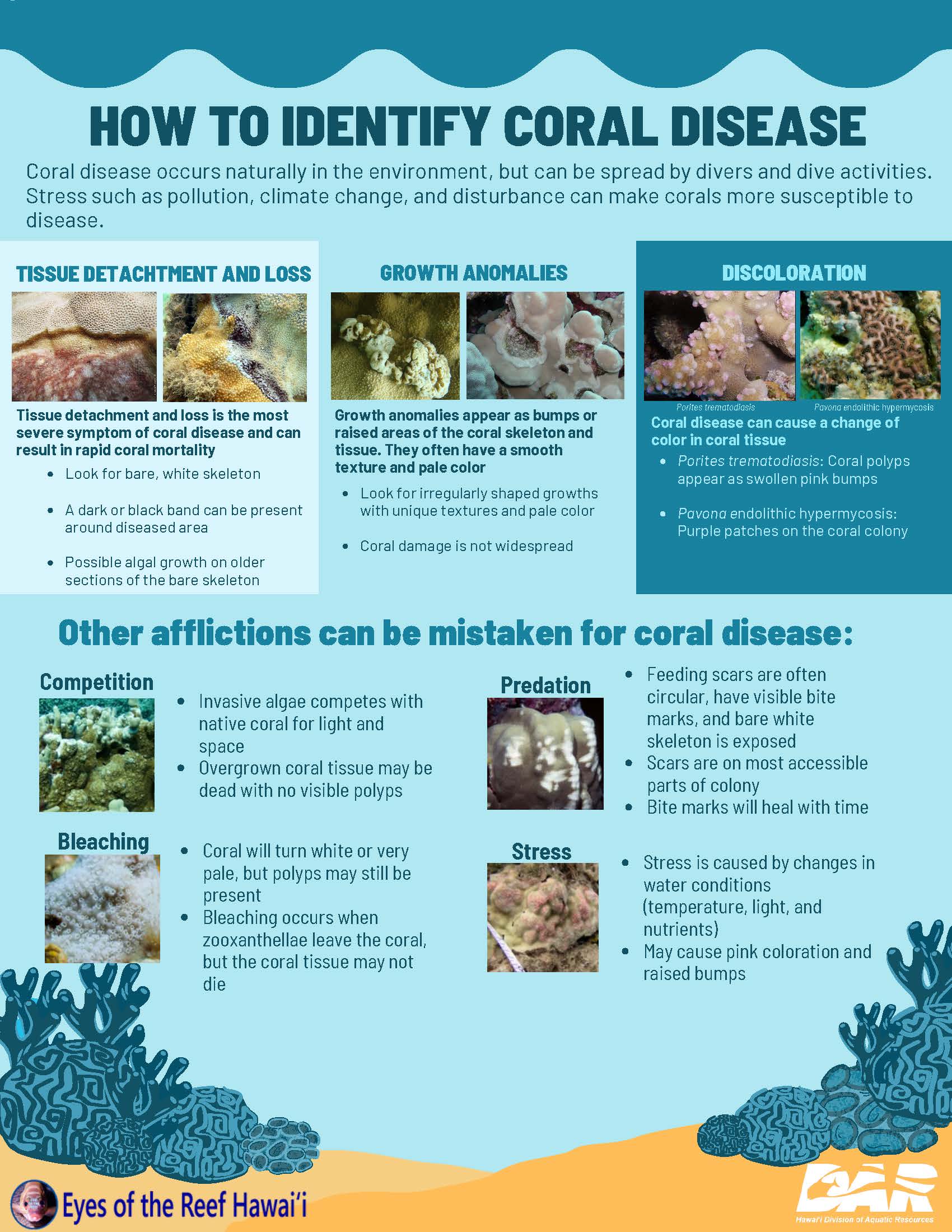
- Monitor the reefs. When diving or snorkelling look out for stony corals that have lesions of tissue mortality. Take photos if possible.
- If you have observed the disease, make a report using the freely available IMA’s SeaiTT app or email [email protected]. Be sure to include information on the (i) location of the observation, (ii) depth of observation, (iii) type of coral species infected and (iv) number of corals infected. Submit your photos.
- Do not touch corals. Touching infected corals can spread the pathogen to healthy colonies. Ensure your snorkeling fins and other gear do not come into contact with corals.
- Disinfect snorkeling, diving and fishing gear. Gear can be soaked in a 1 percent bleach solution for 20 minutes and air dried, to kill the pathogen. If chemicals are not on hand, soak the gear in fresh water for at least two hours.
- Disinfect bilge water in boats using a 1 % bleach solution. Allow it to soak for ten minutes then pump out the bilge water as far as possible from any sensitive area.
- When planning dives, visit healthy sites
It is important to acknowledge the devastation caused by the disease in the Caribbean and work together to protect coral reefs.
The protection of coral reefs requires a whole-of-society approach, as everyone has a duty to preserve the ecological and economic services of reefs and to be proactive in implementing management strategies to protect the country’s corals from the looming threat of the Stony Coral Tissue Loss Disease.