Edgar Batz
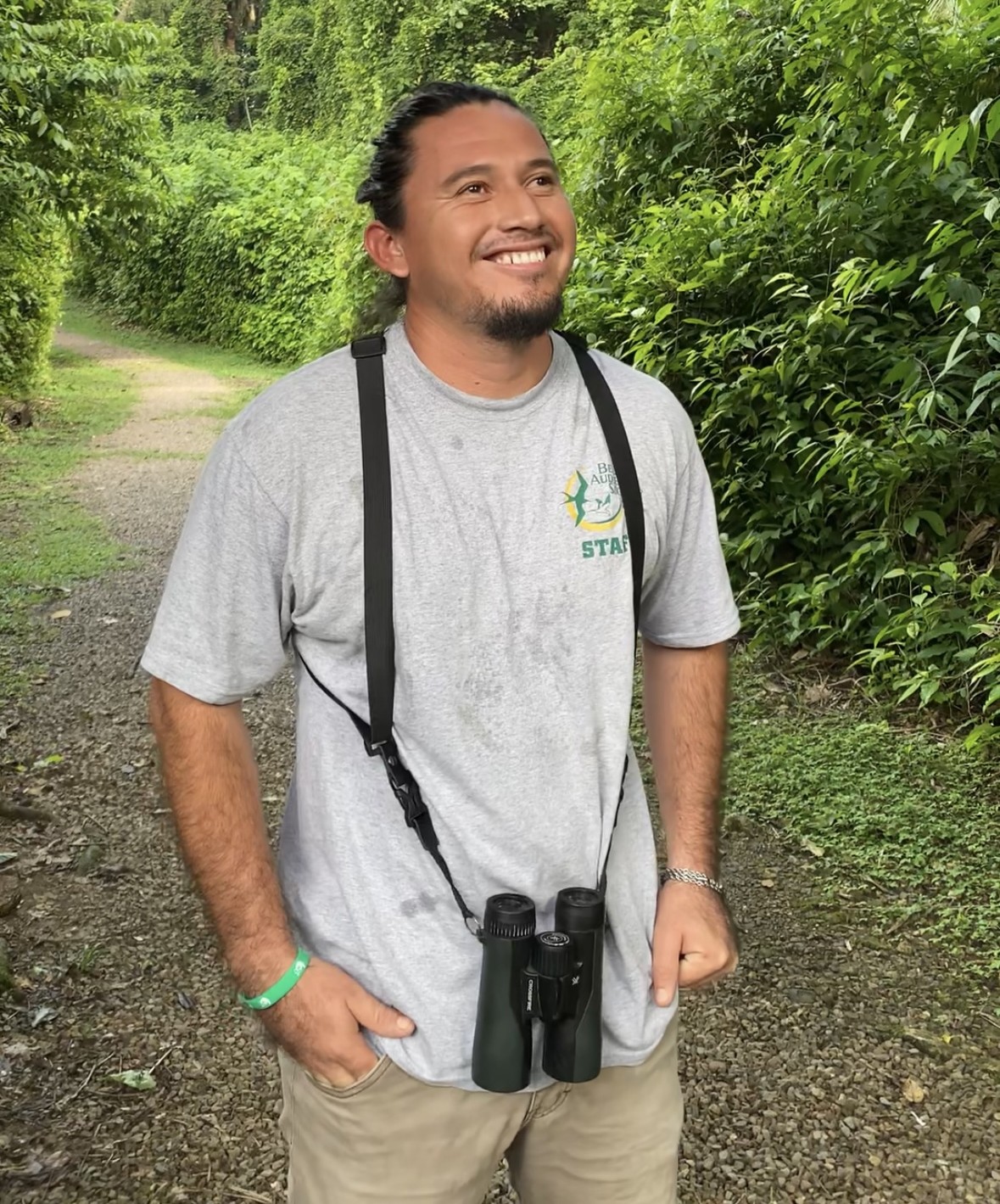
Working with co-manager Belize Audubon Society (BAS) since 2017, Batz recalls his catalyst for conservation being community outreach through environmental education in his own childhood.
“I actually remember coming to St Herman’s with a school trip in primary school and loved it. Then in high school, I had an internship opportunity to spend a few days on Blackbird Caye inside Turneffe Reef Atoll. Those two opportunities [for biodiversity research] made me realise that, wow, I can actually make a career out of the outdoors.”
Years later, after those exposure trips, he finds himself working with the most significant and oldest non-governmental conservation organisation in Belize.
While the Belize Audubon Society’s history in protected area management grew from protecting bird habitats in the 1960s, it’s now much more than birds.
“I can call myself a birder now, yes,” he laughs, recalling his inexperience during the first few days in the field.
“I was actually waiting to be assigned a pair of binoculars, and [St. Herman’s] didn’t have any available for me yet. That’s when I bought my own [from the BAS headquarters] because I was excited to simply start [birding].
“I started doing construction for the Visitor’s Centre and noticed the rangers left the base early in the morning with just a clipboard, and I had so many questions.
“It was amazing seeing these park rangers identify birds just from their songs, purely from practice. When the vacancy popped up, the park manager suggested applying. Here I am, almost 7 years later, proudly working in conservation.”
Miguel Sho

Another Belizean conservationist whose roots are intertwined with St Herman’s Blue Hole National Park is Miguel Sho.
After joining as a full-time park ranger in 2016, Miguel has worked his way up the ranks of the Belize Audubon Society’s Belize City headquarters—not only as a voice for St Herman’s Blue Hole National Park but for all seven of the Belize Audubon Society’s co-managed protected areas.
Miguel now works as the Environmental Education Officer, who works nationally under the Environmental Education & Community Outreach Programme.
BAS’ first attempt to encourage environmental stewardship started some 40-plus years ago through classroom visits to schools in Belize City and in buffer communities.
“My dad and I participated in the Christmas Bird Count [held by BAS] in Punta Gorda, and that’s really where my curiosity for birds began. After that, he started teaching us more when he could.
“By the time I was a teen, I knew I liked birdwatching, even if it wasn’t something I practiced outside of these citizen science events.”
Like fate, Sho now has the capacity to lead and assist these community events like the Christmas Bird Count, thanks to his field experience as a ranger leading educational activities like the Nature In The Classroom presentation, the Nature School programme, and Bird Club meetings.
Every Friday, at least once a month, Edgar will stand where Miguel once did: prepping an activity and lesson for the buffering community’s schools to spend an hour with theory before first-hand fieldwork about birds in their environment.
Roni Martinez

Considering Martinez has recorded seeing 567 species of Belize’s 602, we’d say his “learn one bird a day” recipe works.
“Magnificent Frigate Bird. Common Black Hawk. Great Kiskadee.”
Roni listed out birds he could ID by sound alone, reciting them under his breath like a prayer.
“When I began birdwatching, it was a very slow process to learn the birds in my area and eventually expand across the country.
“It’s why I chose to step into the role of being an educator because that vacuum existed. Not only was I excited about the beauty of birdwatching, but I also wanted to show others—especially tour guides—that it could also be a career.
“I’d love to see more Belizeans, yes, but I hope to play a part in empowering more women to lead these birding expeditions.”
For the past five years, with the exception of 2020, given social distancing amidst a national lockdown, Martinez has mentored at least 50 students, either under projects led by the Belize Audubon Society for the Bird Tourism Project with the Belize Tourism Board (BTB) in 2015 or independently for resort staff or general students.
Since then, Roni has made personal and professional strides to pitch Belize as the “Birding Nation”.