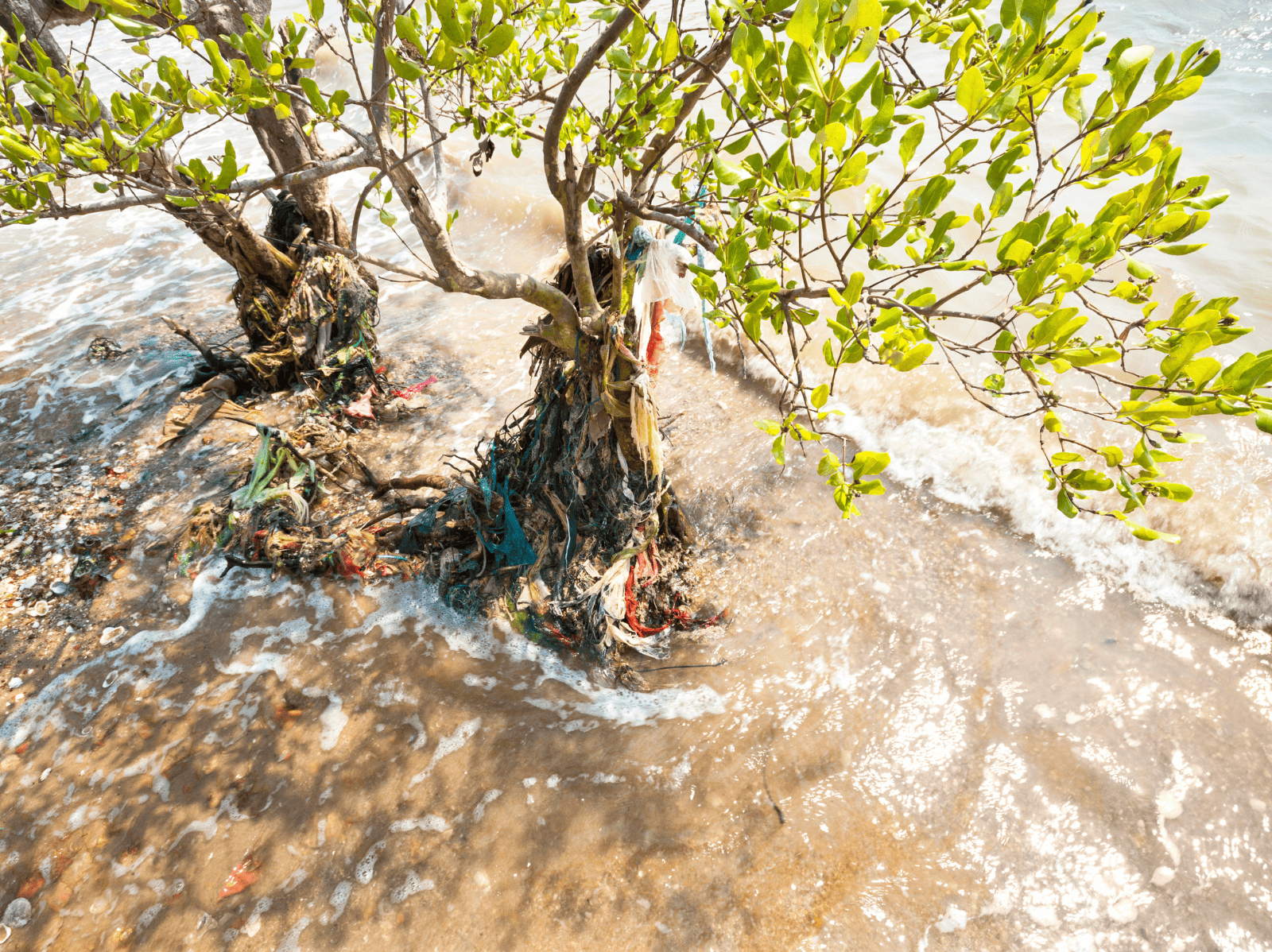

* Note: when the soil was ploughed, layers are plastic waste were identified, which points toward years upon years of plastic pollution in the area.
Photograph by Linton Arneaud
Why now, aren’t we in a Covid-19 pandemic? Besides, what can be done to save mangrove ecosystems? How much money will the economy have to spend in the short-run, and how much will be saved in the long-run? And even so, how can we even effectively save mangroves? These are some of the many questions that warrant answers when talking about the future of mangroves in Trinidad and Tobago (T&T).
According to Environmental Consultant—Dr Linton Arneaud, mangrove ecosystems in T&T can tolerate considerably high percentages of plastic waste before permanent die-back occurs; a phenomenon that prevents ecosystems from recovering naturally. However, he believes that T&T may still have a few years to utilize nature-based intervention to repair the destructive impacts plastic wastes have been inflicting on ecological services provided by mangroves. What is interesting is that Dr Arneaud believes that this initiative may prevent the government from spending billions of US dollars in the near future to mitigate the negative impacts of global warming and climate change due to T&T present increase of plastic wastes within wetlands.
According to an article in Academia Letters, the government of T&T has done considerable work protecting the natural resources, and continue to do so. However, still, up to this day, there are increased reports of flooding; some of which is in areas that have never flooded before, which may be as a result of increased plastic waste on the islands.
Why now, aren’t we in a Covid-19 pandemic?
Dr Arneaud highlighted that “the health and life expectancy of persons living in these general environments (i.e., areas of high plastic waste accumulation) are expected to decrease, as nano and micro-plastics end up being an integral part of humans living there for generations.”
What can be done to save mangroves in T&T?
Dr Arneaud indicated that ideally, fighting the battle of global plastic contamination should be focused on long-term and sustainable approaches such as: education and awareness, cultural transformation, and increasing taxes in cities that have considerably high plastic waste production and an under-utilization of state-own disposal services. However, he believes that these approaches can take decades to achieve, and it may already be too late to safeguard some ecological services provided by mangroves.
Dr Arneaud proposed a cheaper, simpler and innovative way of dealing with such a problem in the short-term; it is to physically remove existing plastic waste from mangrove ecosystems throughout the islands. This will allow mangroves ecosystems to breathe; effectively allowing them to provide their numerous ecological services until long-term mitigation approaches can be enforced.
How much money will the economy have to spend in the short-run, and how much will be saved in the long-run?
In the short-term, nothing, simply stopping any further plastic waste contaminations will allow mother-nature to repair herself. Physically removing plastic waste will accelerate results and prevent the economy from spending billions of US dollars in the long-run.
How can T&T effectively save mangrove ecosystems?
Dr Arneaud strongly believes that acting sooner rather than later may save some mangrove ecosystems in T&T. He further pointed out that proper collaboration between agencies, public education and awareness, commend or reprimand urban communities, monetize recycling, the introduction of Reverse Vending Machines (RVMs), the procurement of a partially state-owned Plastic Recycling Enterprise, the prioritizing of environmental legislations, and continuous research and development can effectively right these wrongs.

Despite numerous international, regional and national initiatives, plastic waste in Trinidad and Tobago seems to still be a serious problem. If the government doesn’t act fast, several ecological functions are expected to collapse.