• About Us
  • Writers
  • Media Gallery
  • Contact Us
Monday, June 22, 2026
No Result
View All Result
JOIN OUR NEWSLETTER
Cari-Bois Environmental News Network
26 °c
Port of Spain
  • Home
  • Agriculture
  • Pollution
  • Climate Change
  • Mining
  • Oil & Gas
  • Forestry
  • Fishing
  • Wildlife
  • Governance
  • More
    • Natural Disaster
    • World Wildlife Day
  • Home
  • Agriculture
  • Pollution
  • Climate Change
  • Mining
  • Oil & Gas
  • Forestry
  • Fishing
  • Wildlife
  • Governance
  • More
    • Natural Disaster
    • World Wildlife Day
No Result
View All Result
Cari-Bois Environmental News Network
No Result
View All Result
Home Wildlife

Jamaican bees are beautiful—and their survival is crucial

by Emma Lewis
May 26, 2021
in Wildlife
0
Photo of stripped honey bee on a purple flower.

Striped honey bee. Photo by Emma Lewis, used with permission.

0
SHARES
529
VIEWS
Share on FacebookShare on LinkedInShare on Whatsapp

This article was written by Emma Lewis and originally published on Global Voices. This version of the article is republished here as part of a content-sharing agreement with Global Voices.


With honey being the valuable product and amazing food resource it is, with proven anti-bacterial and sleep-inducing properties—not to mention its soothing and restorative qualities if you have a cold or the flu—beekeeping has been steadily catching on in Jamaica for some years now.

Patricia Parchment, president of the Westmoreland Bee Farmers Society in Bluefields Bay on Jamaica’s southwest coast. Photo by Wolde Kristos, courtesy Emma Lewis, used with permission.

Women, especially, have been empowered through increased training in beekeeping, offering an alternative source of income during the pandemic and developing skills that will serve them well beyond it. In fact, the new president of the Westmoreland Bee Farmers Society in Bluefields Bay on Jamaica’s southwest coast, is a woman. With the species threatened by man-made impacts and the need to protect these important pollinators being made more acute, bee knowledge has been increasing, both through observation and via online webinars like this one, hosted by the Natural History Museum of Jamaica (NHMJ).

This renewal of interest is rather timely, in the context of both Jamaica’s long history with beekeeping and the urgent threats to bee populations. There are estimated to be as many as 69 species of bees in Jamaica, with the Natural History Museum of Jamaica’s (NHMJ) zoology collection containing approximately 500 specimens across 40 of these species.

Deceita Turner, president of the Bluefields Bay Fishermen’s Friendly Society, works on beehives as a young apprentice watches. Photo by Wolde Kristos, courtesy Emma Lewis, used with permission.

Interestingly, there is a growing number of beekeepers in both rural and urban areas. One young inner-city entrepreneur, Adrian Watson, has been a trained beekeeper for several years; he rears the well-known western honey bees (Apis Mellifera), but Jamaica has far more solitary bees, which are important pollinators. Watson’s Honai Beez Apiary is planning a pollination project that includes an urban beehive, aimed at training new beekeepers and raising awareness of the importance of bees in schools, the private sector and beyond. He hopes to train unskilled young people in beekeeping and is developing sustainable beehives made from bamboo.

Urban beekeeper Adrian Watson admiring his bees. Photo by Watson, used with permission.

A seasoned environmental and climate change campaigner, Watson also advocates for more green spaces in vacant lots in Kingston, the capital, where he lives. These are the areas he has pinpointed for the urban beekeeping activities that are so badly needed for long-term environmental sustainability. The average beehive typically houses about 30,000 bees.

Honey bees are as varied as they are interesting. Their colouring varies from predominantly black, to tan or yellow, depending on their lineage. The British black bee, for instance, is known for its irritability, whereas the New Zealand yellow bee is very docile. Each strain has different properties—fecundity, nectar gathering, longevity—and a good beekeeper will try to breed them for purpose.

Keeping in mind that a queen bee may mate with as many as a dozen drones, various colour combinations may emerge. This is one of the reasons that black bees are less common than tan bees in Jamaica. Either way, they are fascinating creatures, and their pollinating activities make them critical to our survival. Here are some of the most common Jamaican bees in action.

A bee sips water while precariously perched on a plant in a lily pond. Photo by Tracy at Senti Bees, courtesy Emma Lewis, used with permission.

Local bee experts explain that bees use water to control humidity and temperature, and also to dilute honey for consumption by themselves and their larvae. They take the water back to their hives, since temperature and humidity have to be precisely maintained for the well-being of the colony. This is why you sometimes see bees fanning at the hive entrance: the evaporation cools down the residents.
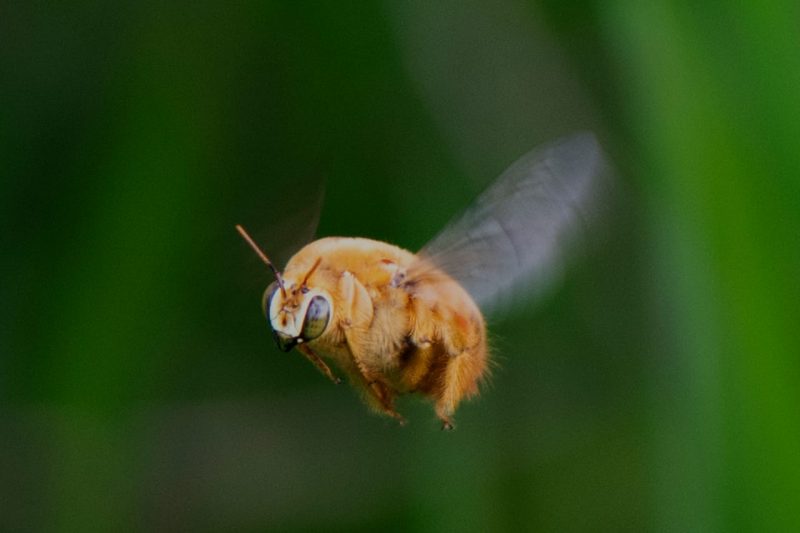
A male carpenter bee on patrol. Photo by Vaughn Turland, courtesy Emma Lewis, used with permission.

Female carpenter bees tend to be black in colour and enjoy the flowers of the moringa tree.

Female orchid bees collecting resin for their nest. Photo: Vaughn Turland, courtesy Emma Lewis, used with permission.

Orchid bees at Marshall’s Pen, a bird sanctuary in Manchester, Jamaica. Photo by Ann Haynes Sutton, courtesy Emma Lewis, used with permission.
One of Jamaica’s large and beautiful native bees, appearing more tan in colour. Photo by Vaughn Turland, courtesy Emma Lewis, used with permission.

This particular native bee, spotted foraging on morning glory flower at a beach in Parottee, St. Elizabeth, is likely of the genus Centris.
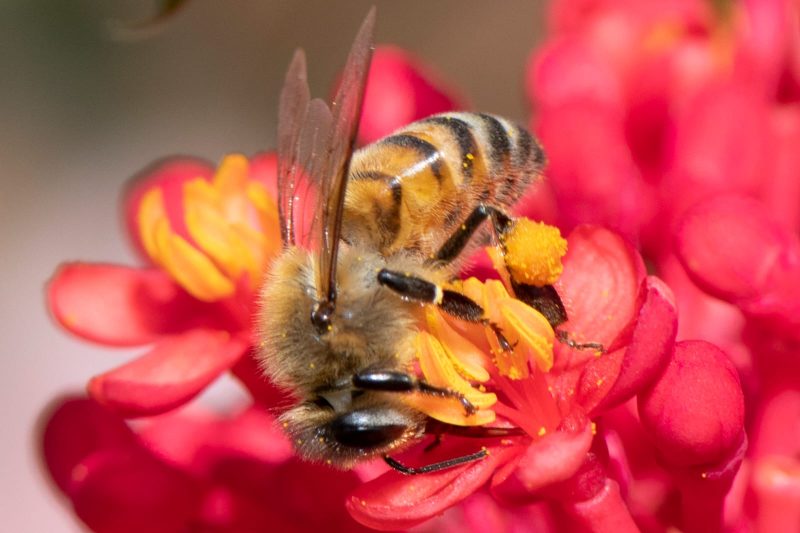
A honey bee gathering pollen. Photo by Vaughn Turland, courtesy Emma Lewis, used with permission.

On the heels of World Bee Day 2021, more and more people from Jamaica—and the rest of the Caribbean archipelago which, as Small Island Developing States, are on the frontline of the climate crisis—are beginning to understand how crucial bees are to the environment and long-term sustainability.

Tags: beekeepingbeescaribbeanJamaica
Emma Lewis

Emma Lewis

Emma Lewis is a writer, blogger and social media activist. Though born in London, she's been living in Jamaica for over 30 years. Her work covers human rights, environmental issues and the problems Small Island Developing States may face.

Next Post
Valencia Flooding: The New Normal?

Valencia Flooding: The New Normal?

Explore by Region

  • Caribbean
  • Antigua and Barbuda
  • Barbados
  • Belize
  • Guyana
  • Haiti
  • Jamaica
  • St Vincent
  • Suriname
  • Trinidad
  • Tobago
  • World
Facebook Twitter Youtube RSS

About Us

Cari-Bois is a Caribbean-wide community that brings together communities, academic, scientists, and journalists, to further educate the region about present-day environmental issues which affect the wellbeing of the region’s natural resources and livelihoods.

Article Categories

  • Agriculture
  • Climate Change
  • Fishing
  • Forestry
  • Mining
  • Natural Disaster
  • Oil & Gas
  • Policy & Governance
  • Pollution
  • Special Reports
  • Wildlife
  • World Wildlife Day

Supported under the 'Caribbean Natural Capital Hub' of ANSA Merchant Bank and ANSA Bank. Learn more here.

© 2024 Caribois Environmental News Network. All Rights Reserved. | Privacy Policy
The contents of this website are the sole responsibility of the project partners and can under no circumstances be regarded as reflecting the position of the European Union.

Welcome Back!

Login to your account below

Forgotten Password?

Retrieve your password

Please enter your username or email address to reset your password.

Log In

Add New Playlist

No Result
View All Result
  • Home
  • Explore By Category
    • Agriculture
    • Climate Change
    • Fishing
    • Forestry
    • Mining
    • Oil & Gas
    • Policy & Governance
    • Pollution
    • Wildlife
    • Natural Disaster
    • Special Reports
    • World Wildlife Day
  • Explore by Region
    • Caribbean
    • Antigua and Barbuda
    • Barbados
    • Belize
    • Guyana
    • Haiti
    • Jamaica
    • St Vincent
    • Suriname
    • Trinidad
    • Tobago
    • World
  • Media Gallery
  • About Us
  • Contact Us

© 2024 Caribois Environmental News Network. All Rights Reserved. | Privacy Policy
The contents of this website are the sole responsibility of the project partners and can under no circumstances be regarded as reflecting the position of the European Union.